 ultimate-guide
HVAC Duct Cleaning Benefits: A 2026 Homeowner's Guide
Table of Contents
- Why Duct Cleaning Benefits Matter in 2026
- How Often to Clean Air Ducts for Your Home
- Signs You Need Duct Cleaning
- What to Expect During Duct Cleaning
- What You'll Need
- Step 1: System Inspection [Time: 20 minutes]
- Step 2: Negative Pressure Setup [Time: 30 minutes]
- Step 3: Agitation and Brush Cleaning [Time: 60-90 minutes]
- Step 4: Register and Component Cleaning [Time: 30 minutes]
- Step 5: Final Verification [Time: 15 minutes]
- Duct Cleaning Scams and Red Flags to Watch For
- Post-Cleaning Maintenance Checklist
- Frequently Asked Questions
Last Updated: September 30, 2026
Why Duct Cleaning Benefits Matter in 2026
Duct cleaning benefits start with the air your family breathes every day. The average person spends roughly 90% of their time indoors, and your ductwork touches nearly every room in the house. When dust, pollen, and debris build up inside that system, you notice it in ways that go beyond a dusty shelf.
How Often to Clean Air Ducts for Your Home
Clean now if any of these are true:
- Recent renovation or construction pulled drywall dust, sawdust, or insulation fibers through the system
- Pets shed heavily year-round and you see matted hair on return grilles
- A household member has asthma or allergies that worsen indoors
- Water intrusion, visible mold, or a musty smell traces back to the ductwork
- You just moved into a home where the previous owner never serviced the system
- You can see debris puffing out of a supply register when the blower starts
You can likely wait if all of these are true:
- Filters are changed on schedule and stay relatively clean between changes
- No recent renovation, water event, or pest activity
- No one in the home reports new or worsening respiratory symptoms
- Registers and grilles show only a light, even film of dust
If none of the "clean now" triggers apply, you may go years longer between cleanings. If two or three apply, don't wait, and don't let anyone talk you into a recurring annual contract you didn't ask for.
Signs You Need Duct Cleaning
Your system usually tells you before it fails, but the signals are easy to misread, and that misreading is exactly what predatory duct cleaning outfits exploit. Here's how to tell a real problem from normal operation, and how to avoid paying for a service you don't need.
Visible Dust and Debris Around Vents
Pull a supply register and look inside with a flashlight. A thin, even film of dust is normal, every system has it. What matters is the pattern:
- Normal: light, uniform dust on duct walls; a slightly gray filter at change time
- Concerning: a visible layer of debris, pet hair matted on the duct walls, or particles puffing out when the system kicks on
- Serious: standing debris, insulation fibers, or evidence of pest activity (droppings, nesting material)
Musty Odors and Allergy Symptoms
A musty smell when the heat or AC starts points to moisture somewhere in the system, and moisture often means microbial growth. If allergy symptoms spike indoors but ease when you're away, your ductwork may be part of the problem. Pet dander and volatile organic compounds settle in ducts over time and get stirred back into the air with every cycle.
The Scam Signals to Watch For
The biggest red flag is a price that sounds too good to be true. Extremely cheap advertised rates often turn into high-pressure upsells once the crew is inside your home. Watch for these:
- A technician who "discovers" mold without any lab testing
- Pressure to sign same-day for chemical treatments or sealants
- No license, bonding, or insurance documentation on request
- Quotes given over the phone without any inspection
- Companies that can't explain what equipment they use or how they verify results
- A crew that finishes in under an hour on a whole-house system, real cleaning takes longer
- No before-and-after photos offered or provided
What a Real Diagnosis Looks Like
Before any cleaning, a legitimate technician should inspect the air handler, check for asbestos-containing materials in older ductwork, look for moisture or damaged duct sections, and confirm airflow at the registers. That inspection is what separates a service call from a sales call. Ask for it in writing.
What to Expect During Duct Cleaning
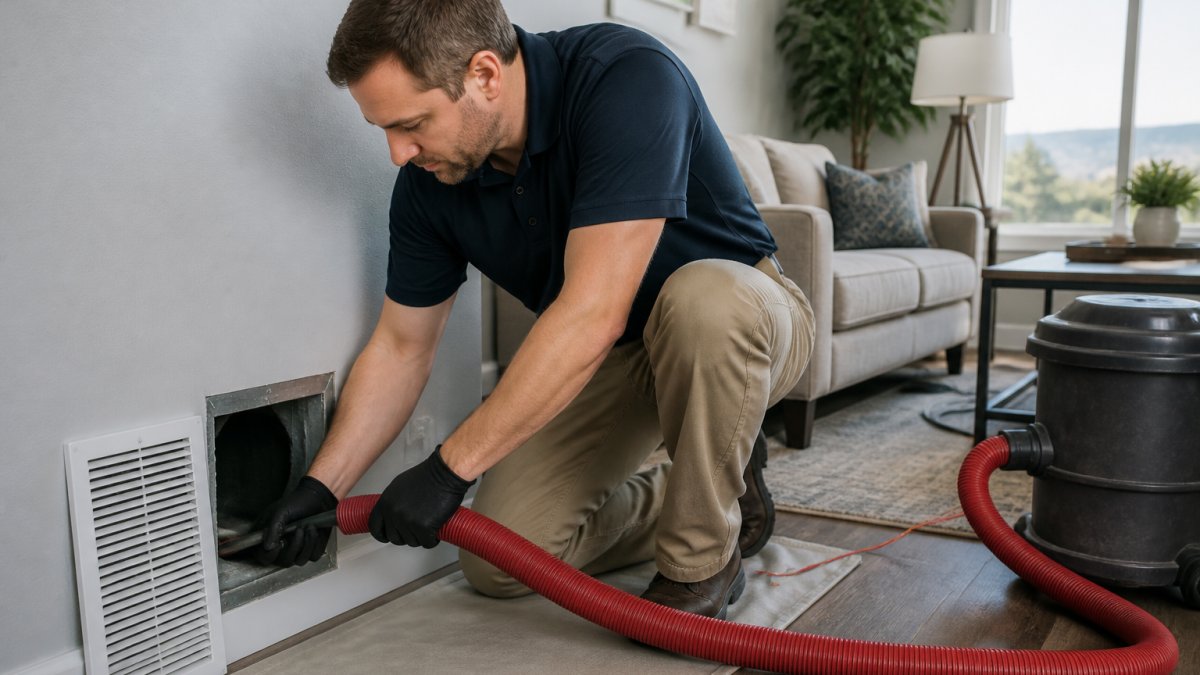
A legitimate cleaning takes two to four hours for an average home. Here's the sequence a professional crew follows.
Total Time: 2-4 hours Difficulty: Professional service recommended
What You'll Need
- Clear access to all supply registers and return vents
- Pets and small children kept in a separate room during service
- A few hours at home for the walkthrough
Step 1: System Inspection [Time: 20 minutes]
The technician inspects your air handler, checks for asbestos-containing materials, and looks for moisture or damaged duct sections before touching anything.
Expected Result: A written assessment of what can safely be cleaned.
Schedule your complimentary consultation →
Step 2: Negative Pressure Setup [Time: 30 minutes]
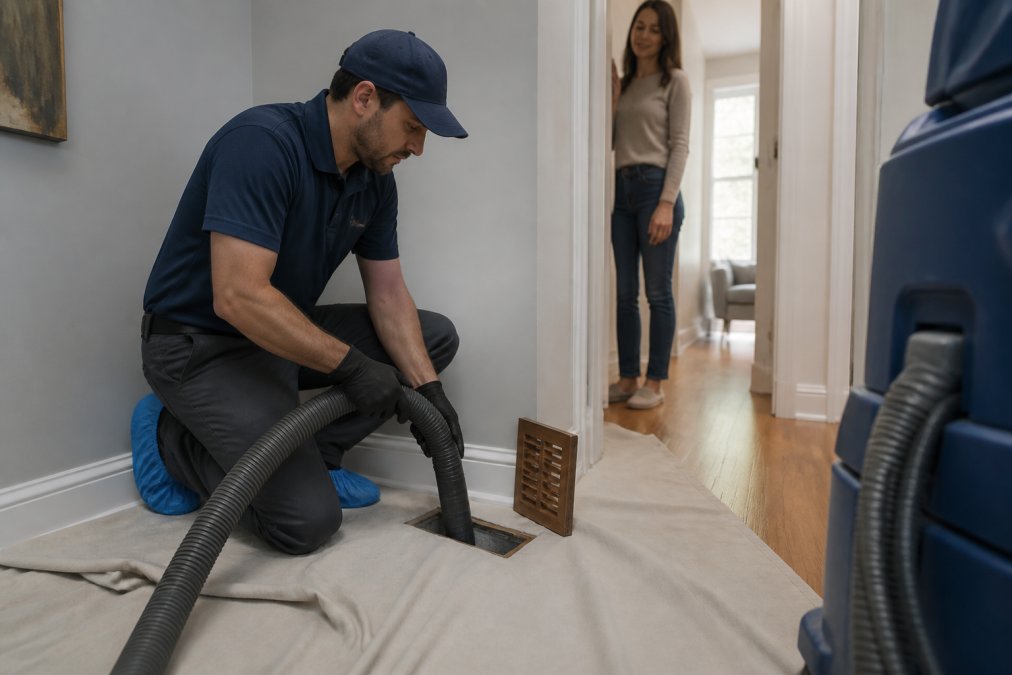
A powerful vacuum connects to the main trunk line and pulls the whole system under negative pressure, so loosened debris travels out instead of into your living space.
Step 3: Agitation and Brush Cleaning [Time: 60-90 minutes]
Rotary brushes and compressed air tools dislodge buildup from duct walls, then the vacuum captures it.
Step 4: Register and Component Cleaning [Time: 30 minutes]
Supply registers, return grilles, and accessible components get cleaned individually.
Step 5: Final Verification [Time: 15 minutes]
The crew confirms airflow at each register and shows you before-and-after photos.
Duct Cleaning Scams and Red Flags to Watch For
The biggest red flag is a price that sounds too good to be true. Extremely cheap advertised rates often turn into high-pressure upsells once the crew is inside your home. Watch for these:
- A technician who "discovers" mold without any lab testing
- Pressure to sign same-day for chemical treatments
- No license, bonding, or insurance documentation on request
- Quotes given over the phone without any inspection
- Companies that can't explain what equipment they use
Post-Cleaning Maintenance Checklist
- Replace filters every 1-3 months, more often with pets
- Vacuum supply registers monthly with a brush attachment
- Check condensate lines for clogs each season
- Keep return vents unblocked by furniture
- Schedule a professional system inspection annually
- Address any water intrusion immediately
One more angle most guides skip: duct sealing. If your ducts leak, cleaning them just means you're pulling conditioned air through gaps in the attic. Valley View HVAC designs solutions around the Willamette Valley's humidity swings, and part of that work is making sure the duct system itself is airtight before anything else.
Frequently Asked Questions
Does cleaning air ducts really make a difference?
Duct cleaning benefits are most noticeable when ducts have visible dust, mold, or pest debris. The EPA notes that dirty ducts aren't automatically a health risk, but cleaning can improve airflow and reduce allergens if your system has buildup. If you have pets, allergies, or recent renovations, the difference is often clearer. For homes with no visible contamination, the improvement may be minimal.
How often should HVAC ducts be cleaned for optimal performance?
Most homes benefit from duct cleaning every 3 to 5 years, though this depends on factors like pets, smoking, recent renovations, or water damage. Homes with allergy sufferers or multiple pets may need service every 2 to 3 years. A qualified technician can assess your ducts during routine HVAC maintenance and recommend timing based on actual buildup, not a fixed schedule.
What are the downsides of duct cleaning?
Poorly done duct cleaning can stir up dust, damage flexible ductwork, or spread contaminants if the technician doesn't use proper containment. Some companies upsell unnecessary chemical treatments. The EPA warns against duct cleaners who make sweeping health claims without evidence. Choosing a licensed, insured provider with clear pricing and no pressure tactics avoids most downsides.
Will my house be dusty after duct cleaning?
A properly executed cleaning should not leave your home dustier. Technicians use negative air machines and containment barriers to capture debris at the source. Some dust may settle on surfaces near vents during the process, so a quick wipe-down afterward is normal. If your home is noticeably dustier for days, that's a sign the job wasn't done correctly.
Is it worth it to clean ducts when you buy a house?
Buying a home is one of the best times to schedule duct cleaning. You don't know the previous owner's habits, and there may be pet dander, smoke residue, or construction dust in the system. The EPA recommends addressing visible mold or pest issues before moving in. A pre-move cleaning gives you a fresh start and lets you inspect the ducts for damage or leaks.
Does cleaning air ducts really make a difference in indoor air quality?
It can, but results vary. If your ducts contain mold, rodent droppings, or heavy dust, cleaning removes those sources and can reduce airborne contaminants. The EPA says duct cleaning alone isn't a cure-all; you also need proper filtration, ventilation, and humidity control. Combining duct cleaning with a high-efficiency filter and regular HVAC maintenance delivers the biggest indoor air quality gains.
What are the potential downsides or risks of duct cleaning?
Risks include damage to ductwork from aggressive brushing, release of contaminants if containment isn't used, and unnecessary chemical applications. Some contractors use scare tactics about health effects to push services. The EPA advises skepticism toward companies that make broad health claims. Verify licensing, ask about equipment and process, and get a written scope of work before agreeing.