 ultimate-guide
HVAC Maintenance for Rural Oregon Homes: 2026 Guide
Table of Contents
- Why Rural Homes Face Unique HVAC Maintenance Challenges
- HVAC Maintenance Checklist for Homeowners
- How Often to Change HVAC Filters in Rural Areas
- Signs of HVAC System Failure You Should Never Ignore
- What a Professional HVAC Maintenance Visit Includes
- DIY Maintenance vs. Professional Service: Where to Draw the Line
- Building a Year-Round HVAC Maintenance Schedule
- Frequently Asked Questions
Last Updated: September 27, 2026
Why Rural Homes Face Unique HVAC Maintenance Challenges
Rural Willamette Valley homes face HVAC maintenance challenges city homeowners rarely encounter: longer service distances, temperature swings between valley floor and foothills, and older housing stock. For rural homeowners, hvac maintenance is the difference between a system that lasts fifteen years and one that fails mid-winter.
Three factors make rural systems work harder:
- Temperature spread. Properties at higher elevations see wider day-night swings than valley-floor homes, forcing more heating and cooling cycles.
- Dust and pollen load. Rural homes sit closer to agricultural dust, orchard pollen, and woodsmoke, which clog filters and coils faster.
- Well water and humidity. Homes on private wells often deal with higher indoor humidity, which stresses cooling systems in summer.
HVAC Maintenance Checklist for Homeowners
An hvac maintenance checklist for homeowners splits into three tiers: monthly tasks you handle yourself, seasonal tasks tied to heating and cooling changeovers, and annual professional service.
Monthly Tasks
- Check the air filter and replace or clean it if visibly loaded
- Clear debris from around the outdoor condenser unit
- Confirm the thermostat is holding the set temperature
- Listen for new rattles, hums, or short cycling
Seasonal Tasks
- Flush the condensate drain line before cooling season
- Vacuum return vents and registers
- Inspect visible ductwork for disconnected joints or pest damage
- Test the heat cycle before the first cold snap
Annual Professional Service
- Full system diagnostics and safety inspection
- Coil cleaning and refrigerant level check
- Electrical connection tightening and blower motor inspection
- Thermostat calibration
That third tier is where most rural homeowners fall behind, and it matters most.
How Often to Change HVAC Filters in Rural Areas
Change HVAC filters every one to three months in rural areas, not the three-to-six months recommended for suburban homes, rural properties pull in more airborne debris, so the filter loads faster. But the more useful question is which filter, because the wrong choice can cost more airflow than it saves in captured dust.
What Actually Loads a Rural Filter
Four contaminant streams hit rural homes harder:
- Woodsmoke and ash. Homes that heat with wood stoves or fireplaces pull fine ash into the return, which packs a filter face faster than household dust.
- Orchard and grass pollen. Seasonal spikes in agricultural areas can double filter loading for four to six weeks in spring.
- Agricultural dust. Tilling, harvest, and livestock operations put coarse particulate into the air that a 1-inch filter captures quickly.
- Well-water humidity. Higher indoor moisture in homes on private wells can cause a loaded filter to support mold growth, which then gets distributed through the ductwork.
Filter Frequency by Condition
| Condition | Filter Check Frequency | Why It Matters |
|---|---|---|
| Standard 1-inch filter, no pets, no wood heat | Every 60 days | Baseline for most rural homes |
| Pets or wood heat | Every 30 days | Hair and ash load filters quickly |
| Near farmland or orchards | Every 30 days | Dust and pollen spike seasonally |
| Thick pleated filter (4-5 inch) | Every 90 days | More surface area, slower loading |
| Two return grilles | Check both, same interval | One grille often loads first and masks the other |
MERV Rating: The Trade-Off Rural Homeowners Get Wrong
Higher MERV is not automatically better. A MERV 13 filter captures more fine particulate, but on an older rural system with a fixed-speed blower, that resistance can drop airflow enough to freeze the evaporator coil in summer or trip the high-limit switch in winter.
- MERV 8 is the safe default for most rural systems with 1-inch filter slots.
- MERV 11-13 is reasonable only if the system was designed for it or uses a 4- to 5-inch media cabinet.
- MERV 16 and above belongs on hospital and cleanroom equipment, not a residential rural system.
How to Tell a Filter Is Done
A common mistake is judging a filter by sight alone. Hold it up to light: if you cannot see through it, it is done, regardless of how long it has been in. Second check: if the blower wheel has visible dust buildup, the filter has been passing particulate it should have caught.
When to Move to a Bigger Filter Cabinet
If you are changing a 1-inch filter every 30 days during pollen season, the slot is undersized. A 4- to 5-inch media cabinet typically extends change intervals, reduces blower strain, and can offer long-term value, but a licensed technician should size it to your system's static pressure rating, not a homeowner swap.
Signs of HVAC System Failure You Should Never Ignore
The clearest signs of HVAC system failure are rising energy bills without a usage change, weak airflow, strange odors, and frequent cycling. Any one warrants a diagnostic visit before the problem compounds.
Watch for these specific signals:
- Short cycling. The system turns on and off every few minutes. This often points to an oversized unit, a failing thermostat, or low refrigerant.
- Rotten egg smell. Stop and call a technician. This can indicate a gas or combustion issue.
- Ice on the outdoor unit. Restricted airflow or low refrigerant, not just cold weather.
- Uneven room temperatures. Frequently a ductwork inspection issue rather than an equipment failure.
- Grinding or screeching. Usually a blower motor or bearing problem that gets worse with delay.
What a Professional HVAC Maintenance Visit Includes
A professional HVAC maintenance visit covers system diagnostics, coil cleaning, refrigerant level checks, electrical connection inspection, drain line cleaning, and a safety inspection. A thorough visit takes one to two hours depending on system type and condition.
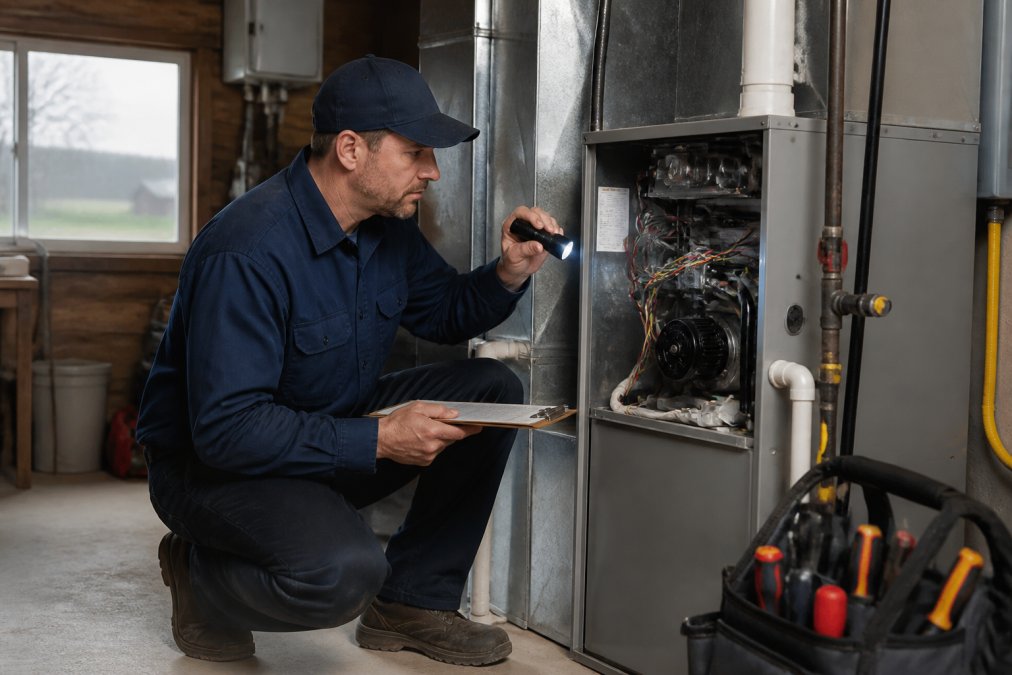
- Filter and airflow. Confirm the filter is correct for the system and check static pressure.
- Coils. Clean the evaporator and condenser coils. Dirty coils are one of the most common efficiency killers.
- Refrigerant. Check charge levels and look for leaks.
- Electrical. Tighten connections and test capacitors and contactors.
- Blower motor. Measure amp draw and lubricate where applicable.
- Drain line. Flush and confirm the condensate path is clear.
- Safety inspection. Test the heat exchanger, gas connections, and carbon monoxide output on combustion systems.
DIY Maintenance vs. Professional Service: Where to Draw the Line
DIY maintenance covers filters, vents, outdoor unit clearance, and basic thermostat checks. Professional service is required for refrigerant handling, electrical diagnostics, gas and combustion safety, and any sealed-system repair.
Schedule your complimentary consultation →
What homeowners can safely do:
- Replace filters on schedule
- Keep the outdoor unit clear of leaves, snow, and vegetation
- Flush the condensate drain with water and vinegar
- Vacuum registers and return grilles
- Track filter dates and system behavior
What requires a professional:
- Any refrigerant check, top-off, or leak repair
- Electrical diagnostics and component replacement
- Gas line, burner, and heat exchanger inspection
- Ductwork repair and sealing
- Compressor or blower motor work
Building a Year-Round HVAC Maintenance Schedule
A year-round schedule pairs monthly homeowner checks with two professional visits, one before heating season and one before cooling season. For rural homes, it must also account for three things suburban guides ignore: the fuel source, the power supply, and the distance a technician drives to reach you.
Start With Your Heat Source
The calendar looks different depending on what heats the house.
- Propane furnace. Annual fall service is non-negotiable. Propane burns dirtier than natural gas in some setups, and burner and heat exchanger inspection catches soot and cracking before carbon monoxide becomes a risk. Propane delivery logistics also mean you want the system running efficiently before the first cold snap, not after.
- Electric heat pump. Two visits, not one. The reversing valve, defrost cycle, and auxiliary heat strips all need checking in fall, and the cooling-side charge and coil need checking in spring. Heat pumps run year-round, so they accumulate runtime faster than a furnace that sits idle half the year.
- Dual-fuel (heat pump + propane backup). The changeover setpoint is the single most important thing to verify. If it is set wrong, the system runs on the more expensive fuel all winter.
- Wood or pellet supplement. Your HVAC filter schedule tightens, and the chimney or flue needs its own annual inspection separate from the HVAC visit.
The Rural-Specific Calendar
| Season | Homeowner Tasks | Professional Tasks |
|---|---|---|
| Spring (March-April) | Filter check, clear winter debris from condenser | Cooling tune-up, coil cleaning, refrigerant check, condensate flush |
| Summer (June-August) | Monthly filter checks, watch for short cycling in heat waves | None scheduled, save the visit for a real problem |
| Fall (September-October) | Filter check, test heat cycle before first cold night | Heating tune-up, heat exchanger test, burner inspection, safety check |
| Winter (December-February) | Monthly filter checks, keep snow and ice off the outdoor unit | None scheduled, priority scheduling matters here |
Power Quality on Rural Grids
Rural service runs on longer distribution lines with more exposure to tree contact, wind, and lightning, meaning more frequent voltage sags and surges than a suburban feeder. Two protections are worth building into the schedule:
- Whole-home surge protection at the panel, checked annually. A single surge can take out a control board, a capacitor, or a variable-speed blower module.
- A hard-start kit or soft-start device on older compressors, which reduces the inrush current that stresses a motor every time it starts. On rural power, that stress adds up.
Service Contracts and the Real Value of Priority Scheduling
A service contract typically bundles both professional visits and priority scheduling. For rural homeowners, priority scheduling is the real value: emergency repair during a cold snap means waiting behind every other call in the queue, and the technician still has a 45-minute drive to reach you.
What to Confirm Before You Sign a Contract
Ask three questions before committing:
- Does the contract cover both visits, or only one? Some bundle only the heating tune-up and charge separately for cooling.
- What is the priority-scheduling window? "Priority" means nothing if the guaranteed response is still five days.
- Are travel or mileage fees included? On rural routes, a per-mile charge can erase the contract discount.
For homeowners in the Willamette Valley who want a schedule built around their specific property, fuel source, and system, Valley View HVAC offers maintenance plans designed for the region's climate. The team is fully licensed, bonded, and insured, backed by a 2-year workmanship warranty, and offers community discounts for seniors, veterans, educators, and first responders.
Frequently Asked Questions
How often should I schedule professional HVAC maintenance for a rural home?
Schedule professional HVAC maintenance twice a year: once in spring for your cooling system and once in fall for your heating system. Rural homes often need more frequent service because dust, pollen, and debris from surrounding fields and trees clog filters and coils faster than in suburban settings. If you rely on a heat pump for year-round comfort, one comprehensive annual visit may cover both modes, but ask your technician to confirm.
Can I perform basic HVAC maintenance myself or do I need a professional?
You can handle simple tasks like replacing air filters, clearing debris from the outdoor condenser unit, and keeping vents unobstructed. However, tasks involving refrigerant levels, electrical connections, blower motors, and system diagnostics require a licensed technician. Attempting those repairs yourself can void warranties and create safety hazards. A good rule: if it involves opening a panel, handling refrigerant, or testing electrical components, call a professional.
How does rural living affect the lifespan of an HVAC system?
Rural environments expose HVAC systems to more airborne debris, temperature swings, and power fluctuations than suburban areas. Without regular maintenance, these factors can shorten a system's lifespan. Homes that follow a consistent HVAC maintenance checklist and address signs of HVAC system failure early often get the full expected service life from their equipment. Neglecting filter changes and coil cleaning accelerates wear on the blower motor and compressor.
What are the signs that my HVAC system needs immediate professional attention?
Call a technician right away if you notice unusual grinding or squealing noises, a burning smell, refrigerant leaks, frequent cycling, or a complete loss of heating or cooling. Weak airflow combined with rising energy bills also signals a problem. In rural areas, where extreme weather can leave you without service for days, addressing these signs early prevents emergency repairs and keeps your home safe during heat waves or cold snaps.