 how-to
Why Is My House Temperature Inconsistent? Fix It Fast
Table of Contents
- Quick Checks Before You Call an HVAC Technician
- Thermostat Calibration Guide: Is Your Thermostat Lying to You?
- How to Balance Airflow in House: Supply, Return, and Dampers
- Signs of a Failing HVAC Blower Motor and What to Do Next
- Ductwork, Insulation, and the Thermal Envelope: Where Conditioned Air Escapes
- Why Your House Temperature Is Inconsistent Across Floors and Rooms
- Smart Home Solutions and DIY Diagnostic Testing for Inconsistent House Temperature
- When to Call a Professional for Inconsistent House Temperature
- Frequently Asked Questions
Last Updated: September 25, 2026
Quick Checks Before You Call an HVAC Technician
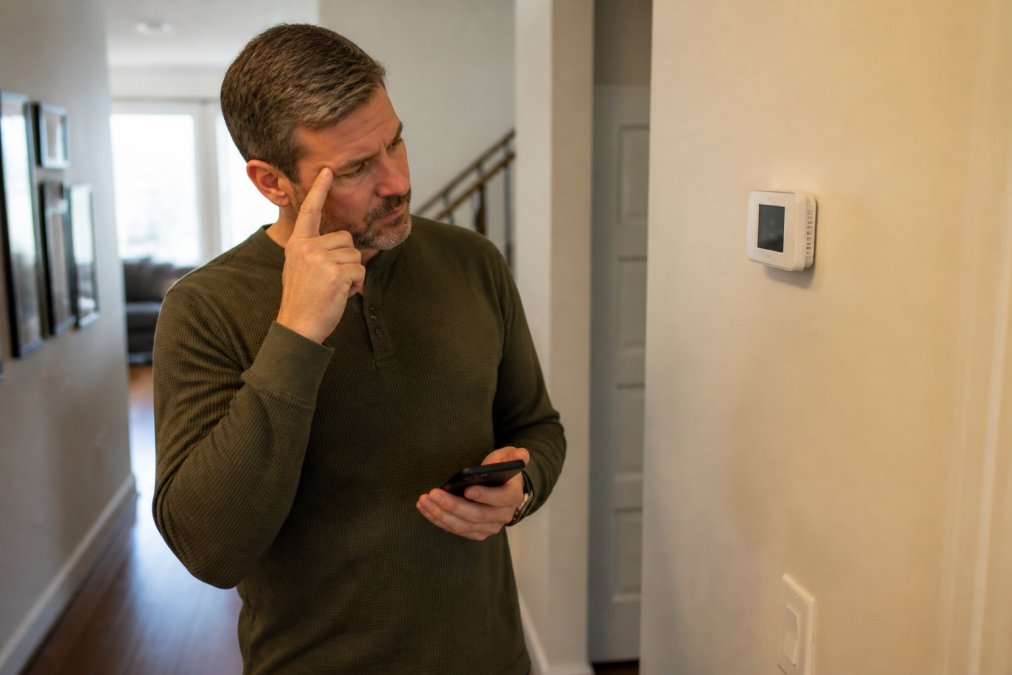
If you're asking why is my house temperature inconsistent, start with three free checks before paying for a service call.
Here's what to check first:
- Thermostat batteries and settings. Dead batteries cause wild readings. Check the fan is set to "auto," not "on."
- Air filter condition. A clogged filter chokes airflow and throws off every room.
- Blocked vents. Furniture, rugs, and curtains over supply registers kill air distribution.
- Thermostat location. Direct sun, lamps, or drafty hallways skew readings badly.
Thermostat Calibration Guide: Is Your Thermostat Lying to You?
A thermostat calibration guide starts with one test: place a separate thermometer two feet from your thermostat and compare readings after 15 minutes. A gap of 2 degrees or more means it's off. Thermostat calibration corrects the displayed temperature to match the actual room temperature, and most digital thermostats drift over time. To test yours:
- Tape a reliable thermometer next to the thermostat.
- Run the system for 15 minutes.
- Compare both readings at the same moment.
- Note any difference above 2 degrees.
- Check your thermostat manual for a calibration offset setting.
How to Balance Airflow in House: Supply, Return, and Dampers
Learning how to balance airflow in house comes down to one principle: every room needs the right mix of supply and return air. When that breaks, some rooms bake while others freeze.
Start with these steps:
- Open every supply register fully.
- Make sure return vents aren't blocked by furniture.
- Check that dampers in the duct branches are open.
- Close registers slightly in the hottest rooms to push air elsewhere.
- Never close more than 20% of your registers at once.
| Problem | Likely Cause | Quick Fix |
|---|---|---|
| One room always cold | Damper closed or blocked vent | Open damper, clear register |
| Whole house uneven | Filter clogged | Replace filter |
| Upstairs too hot | Poor return airflow | Add or open returns |
| Rooms near thermostat fine, far rooms off | Thermostat location | Relocate or add sensors |
Signs of a Failing HVAC Blower Motor and What to Do Next
The clearest signs of a failing HVAC blower motor are weak airflow from every vent, a humming sound before the fan starts, and rooms that never reach the set temperature.
Watch for these signals:
- Airflow feels weak at all registers, not just one.
- You hear grinding, rattling, or humming.
- The fan runs slow or won't start.
- Energy bills climb with no change in use.
- The breaker trips when the system starts.
Ductwork, Insulation, and the Thermal Envelope: Where Conditioned Air Escapes
Your thermal envelope is the barrier between your living space and the outside. When it leaks, no thermostat fiddling will fix an inconsistent house temperature.
Check these common escape points:
- Duct leaks at joints, especially in attics and crawlspaces.
- Kinked or crushed ducts that choke airflow.
- Thin attic insulation that lets heat pour in or out.
- Air leakage around windows, doors, and outlets.
- Missing duct insulation in unconditioned spaces.
Why Your House Temperature Is Inconsistent Across Floors and Rooms
Warm air is less dense, so it migrates upward through stairwells, chases, and gaps around plumbing while cooler air settles below. HVAC pros call this the stack effect, and in a two-story home it can produce a 5 to 10 degree spread between floors even when the system runs perfectly. Your single thermostat makes this worse: it reads one wall, usually on the first floor or a hallway, and shuts the system off the moment that spot hits the setpoint, upstairs bedrooms may still be 4 degrees warm when the compressor stops.
The layout factors that decide how bad it gets
- Open-concept floor plans. A vaulted great room with an open staircase acts like a chimney, pulling first-floor air up and starving the lower level. Compartmentalized plans trap air where it lands, creating hot rooms near the thermostat and cold rooms at the end of the hall.
- Solar heat gain. West- and south-facing windows can add several degrees in the late afternoon; a room comfortable at 9 a.m. can be 6 degrees warmer by 4 p.m.
- Long duct runs. A bedroom at the end of a 40-foot duct branch in an unconditioned attic receives air that has already given up much of its conditioning.
- Missing returns. Bedrooms with a supply register but no return path rely on undercut door gaps; if the door is closed and the gap is small, the room pressurizes and stops accepting supply air.
- Zoning absence. Large or open homes with one thermostat and one zone will always have a temperature differential. A zoning system with separate thermostats and motorized dampers is the real fix for chronic floor-to-floor gaps.
How to tell which problem you have
Run this quick diagnostic before you call anyone:
Schedule your complimentary consultation →
- Log the temperature on each floor at the same time of day for three days.
- Note whether the gap is constant or only appears in the afternoon (solar gain) or overnight (stack effect).
- Check whether the upstairs rooms have returns, if not, that's your first suspect.
- If the far rooms sit at the end of long, uninsulated duct runs, distribution, not equipment, is the issue.
For two-story homes, a load calculation (often called a Manual J) tells you whether your system is sized correctly for the whole space and each floor's share of it. An oversized unit short-cycles and leaves rooms uneven; an undersized unit runs nonstop and still falls short.
Smart Home Solutions and DIY Diagnostic Testing for Inconsistent House Temperature
This section gives you a repeatable DIY diagnostic you can run in an afternoon, plus the smart-home tools that fix the control problem a single thermostat can't solve.
DIY diagnostic: how to test your own airflow before calling anyone
You don't need a pro to find out whether your problem is distribution or equipment. Run these tests in order.
What smart home tools actually change
Smart thermostats and remote sensors don't fix ductwork, but they change the control logic behind much of the perceived unevenness.
- Remote room sensors. Instead of reading one hallway, the thermostat averages temperatures from sensors in the rooms you actually use, and some systems let you prioritize a specific sensor during specific hours, for example, the nursery overnight.
- Smart vents. Motorized registers open and close on a schedule or in response to sensor readings. They help in mild cases, but they raise static pressure when closed, so use them sparingly.
- Scheduling and geofencing. Balancing comfort when you're home versus away reduces peak-hour load and can narrow temperature swings.
- Alerts. Filter-change reminders and abnormal-runtime alerts catch small problems before they become uneven-room problems.
A seasonal preventative maintenance checklist
Run this checklist twice a year and you'll catch most uneven-temperature causes before they start.
Spring (before cooling season):
- Replace the air filter
- Test thermostat calibration against a separate thermometer
- Clear all supply and return vents of furniture, rugs, and curtains
- Inspect accessible duct joints in the attic or crawlspace for separated connections
- Check that all branch dampers are open
- Log room temperatures on a mild day as a baseline
Fall (before heating season):
- Replace the air filter again
- Re-test thermostat calibration
- Check window and door seals; add weatherstripping where you feel drafts
- Look for new furniture or rugs that may have blocked a register
- Confirm the blower runs smoothly with no humming or grinding
- Re-log room temperatures and compare to your spring baseline
When to Call a Professional for Inconsistent House Temperature
Call a professional when DIY checks don't fix the problem or you see signs of a mechanical fault. Reach out if you notice:
- Weak airflow everywhere after a filter change.
- A blower motor that hums, grinds, or won't start.
- Big temperature gaps that dampers can't fix.
- Suspected duct leaks you can't reach.
- An oversized unit or undersized unit that never kept up.
Frequently Asked Questions
What could be causing the inconsistent temperature in my house?
Inconsistent house temperature usually comes from one of a few sources: thermostat calibration drift, blocked or closed supply registers, duct leaks in unconditioned spaces, an undersized or oversized HVAC unit, poor insulation, or solar heat gain through windows. Start by checking that all vents are open and the air filter is clean. If the problem persists across multiple rooms, a professional can measure static pressure and perform a load calculation to pinpoint the cause.
Can poor insulation cause uneven room temperatures?
Yes. Insulation with a low R-value allows heat to move through walls, ceilings, and floors more easily, so rooms near poorly insulated areas lose conditioned air faster. Rooms above garages or crawl spaces are common culprits. Adding insulation to bring your home up to current U.S. Department of Energy recommendations for your climate zone can reduce room-to-room variance and lower energy loss.
How do I know if my HVAC system is undersized for my home?
An undersized unit runs almost constantly, struggles to reach the set temperature on hot or cold days, and leaves rooms farthest from the air handler noticeably warmer or cooler. An oversized unit short-cycles, which also creates uneven temperatures. A proper load calculation, not a rule-of-thumb guess based on square footage, is the only reliable way to know. Ask your HVAC technician to run one before replacing equipment.
What are the signs that my house thermostat is bad?
A failing thermostat may read a temperature that does not match a separate thermometer placed nearby, lose its programming, turn the system on and off at odd intervals, or show a blank or flickering display. Before replacing it, try fresh batteries and a quick calibration check. If the reading is off by more than a degree or two, or the unit does not respond to adjustments, a technician can confirm whether the thermostat or the HVAC control board is at fault.