 blog
7 Questions That Separate Two HVAC Bids
Last Updated: November 1, 2026
Quick Summary
Comparing hvac bids means checking scope before price: demand a Manual J load calculation, verify license, bond, and insurance, and confirm the permit, labor warranty, and exclusions in writing. Score every bidder on the same written questions so you compare identical work, not just bottom lines.
- Ask every bidder the same questions in writing and score each answer 0, 1, or 2.
- A Manual J load calculation is a room-by-room measurement that determines correct system size.
- Verify license, bond, and insurance through your state contractor licensing database, not a truck logo.
- Ask what is excluded last, then add those items back to compare true totals.
- Equipment and labor warranties are separate contracts: manufacturer covers parts, installer covers labor.
Table of Contents
- Two HVAC Bids, Two Very Different Installations
- The HVAC Contractor Comparison Checklist That Decides It
- How to Do an HVAC Installation Estimate Comparison Line by Line
- Questions to Ask an HVAC Contractor Before You Sign
- HVAC Equipment and Labor Warranties: What the Fine Print Covers
- Ducted Systems, Mini-Splits, and Replacing an Oil Furnace
- Why the Lowest Bid Usually Costs More
- Schedule a Complimentary Consultation Before You Compare Bids
- Frequently Asked Questions
Two HVAC Bids, Two Very Different Installations
According to ENERGY STAR guidance on home heating and cooling, your HVAC system accounts for roughly half of your home's energy use, so the equipment you choose and the crew that installs it matter more than almost any other home improvement decision.
Two quotes for the "same" job can differ by thousands of dollars and still both be technically correct. See how Woodward Heating compares to Aire Serv before you decide. The difference lives in the details nobody puts on the front page.
Below are seven questions that expose what's actually behind each bid, so you can pick the contractor who will still answer your call in year five.
The HVAC Contractor Comparison Checklist That Decides It
A good HVAC contractor comparison checklist turns a gut-feel decision into a paper trail. Start with these four items before you look at price.
- Manual J load calculation included and attached to the bid
- Manual S equipment selection and Manual D duct design referenced
- State license number, bond, and insurance certificate provided
If a bidder can't produce the first two, stop there. Sizing by rule of thumb ("about a ton per 500 square feet") is a common installation mistake, and it can lead to short cycling, high humidity, and premature failure.
Manuals J, S, and D: The Load Calculation Paper Trail
A Manual J load calculation is a room-by-room measurement of your home's heat gain and loss that determines the correct system size. Manual S then matches equipment to that load, and Manual D designs the ductwork to deliver the airflow.
Ask to see all three, or at least the Manual J report. A contractor who skips the load calculation is guessing, and an oversized system cools fast but may not remove humidity properly.
Licensing, Bonding, and Insurance Checks
A licensed HVAC contractor holds a state-issued license, carries a surety bond, and maintains general liability and workers' compensation insurance. Verify all three independently through your state's contractor licensing database rather than trusting a logo on a truck.
The Oregon Construction Contractors Board lets you look up license status, bond history, and complaint records in minutes. Do it for every bidder. A lapsed bond or a complaint pattern tells you more than any sales pitch.
How to Do an HVAC Installation Estimate Comparison Line by Line
An HVAC installation estimate comparison only works if both documents describe the same work. Put the bids side by side and check these lines in order:
| Line Item | What to Verify | Why It Matters |
|---|---|---|
| Equipment | Exact model and SEER2 rating | Base and premium models hide behind the same brand name |
| Load calculation | Manual J attached | Proves the size is right, not guessed |
| Ductwork | Sealing, repair, or replacement scope | Existing ducts often leak and undercut efficiency |
| Line set and electrical | New or reused | Reused line sets can void manufacturer warranties |
| Permit and inspection | Included and pulled by contractor | Unpermitted work complicates resale |
| Thermostat | Model and programming | Cheap thermostats erase efficiency gains |
| Warranty terms | Labor years vs. parts years | The gap is where surprises live |
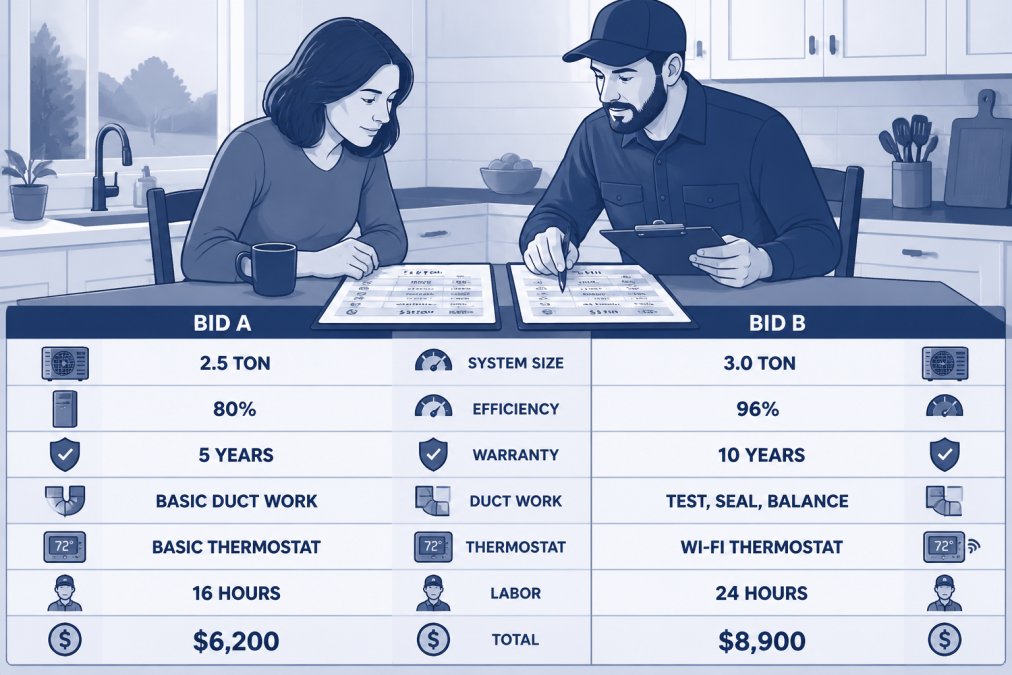
A common mistake is comparing the bottom line before the scope. One bid may exclude the permit, pad, disconnect, or duct sealing; add those back in and the "cheaper" quote often isn't.
Questions to Ask an HVAC Contractor Before You Sign
The right questions to ask an HVAC contractor produce a written answer you can compare against the other bid, not a friendly nod. Ask every bidder the same questions in the same order, in writing, and keep the replies attached to each estimate.
Here is the framework we use when homeowners bring us two bids and ask which one is real. Score each bidder 0, 1, or 2 on every line below. A bidder who cannot answer in writing scores zero on that line, regardless of what was said at the kitchen table.
| # | Question | What a strong answer looks like | What a weak answer sounds like |
|---|---|---|---|
| 1 | Will the Manual J load calculation be attached to my contract? | A room-by-room report with window, insulation, and orientation inputs | "We size by square footage" or "the old unit was a 3-ton, so we'll match it" |
| 2 | Who pulls the permit, and will the work be inspected? | Contractor pulls it; permit number appears on the invoice | "You can pull it if you want" or "we don't usually permit swaps" |
| 3 | What is the labor warranty length, and does it cover refrigerant leaks and diagnostic fees? | Specific years, in writing, with exclusions listed | "One year on labor, standard" with no document |
| 4 | Will the crew that quoted the job also install it? | Named lead installer or a direct yes | "Our install team" with no names or subcontractor disclosure |
| 5 | What is your typical response time for a warranty call in my area? | A stated window and after-hours policy | "As fast as we can" |
| 6 | Do you offer a written workmanship warranty separate from the manufacturer's? | A separate document with term and coverage | "The manufacturer covers everything" |
| 7 | Can you provide two references from installs completed in the last year? | Addresses or phone numbers you can actually call | A logo sheet or a review link |
| 8 | Is the line set new or reused, and does reuse affect my manufacturer warranty? | A clear answer tied to the equipment manual | "Reusing is fine" with no documentation |
| 9 | What is excluded from this quote, pad, disconnect, duct sealing, haul-away, thermostat? | An itemized exclusion list | Silence, or "that's all included" with no line items |
| 10 | How do you handle rebate paperwork and utility incentive documentation? | A named process and who signs | "You handle that part" |
Two questions deserve extra weight. The load calculation: a bidder who attaches a Manual J report has already shown you the sizing logic, and that single document separates a professional proposal from a sales sheet. The labor warranty: it's the only line that tells you what happens in year three when the compressor is fine but the install was not. A contractor who won't put labor coverage in writing is telling you something about their confidence in the crew.
If you're still weighing repair against replacement, our guide on signs your HVAC system needs replacement covers the age, repair-frequency, and efficiency signals that justify a new system.
Schedule your complimentary consultation →
HVAC Equipment and Labor Warranties: What the Fine Print Covers
HVAC equipment and labor warranties are two separate contracts: the manufacturer covers parts, and the installer covers labor and workmanship. Most homeowners read the first and assume the second.
Manufacturer warranties generally cover parts for a set number of years, and their terms should be read carefully for installation and registration requirements.
Labor warranties are where contractors differ most. Some offer one year, some offer none in writing. Ask specifically whether the labor warranty covers diagnostic fees, refrigerant, and after-hours calls.
Ducted Systems, Mini-Splits, and Replacing an Oil Furnace
Not every home needs the same equipment, and the biggest source of mismatched bids is a contractor quoting the system they prefer rather than the one your house supports.
Most ranking pages mention these options and stop. The useful version is a decision framework built on four inputs: home size, existing duct condition, current fuel type, and comfort priorities.
| Your situation | Likely fit | Why | Watch for |
|---|---|---|---|
| Existing ducts in fair-to-good condition, central layout | Ducted heat pump | Reuses distribution; one system conditions the whole house | Duct leakage can erase efficiency gains, budget for sealing |
| No ducts, or ducts undersized or inaccessible | Ductless mini-split | Avoids duct work entirely; zone-by-zone control | Each head needs a wall or ceiling location and a line-set path |
| Oil furnace at end of life, panel capacity adequate | Heat pump, possibly with a backup | Removes oil deliveries and tank risk; cooling comes free | Electrical panel and service upgrade may be needed |
| Oil furnace at end of life, panel capacity tight | High-efficiency gas furnace or hybrid | Lower electrical demand than a full heat-pump swap | Confirm gas service and venting before signing |
| Additions, garages, accessory units | Single-zone mini-split | Cheapest way to condition a space the central system misses | Separate outdoor unit placement and noise |
A few mechanisms matter before you compare quotes.
If a mini-split fits your situation, it can suit older homes and accessory units. Central systems can cover gas and electric options. Whichever path the bids point toward, the comparison only works when both contractors price the same equipment class, a ducted heat-pump quote and a mini-split quote are not competing bids, they are different projects.
Why the Lowest Bid Usually Costs More
The cheapest bid is not always the best value. It is worth checking what may have been left out: the load calculation, the ductwork scope, the permit, or the labor warranty.
A fair-priced bid shows its work: it names the equipment, attaches the load calculation, includes the permit, and puts the warranty in writing. Readers can also review Woodward Heating alternatives for residential homes to see what a fair-priced option looks like.
Schedule a Complimentary Consultation Before You Compare Bids
Comparing bids is easier when you have one solid quote in hand as your benchmark. That's the fastest way to spot what's missing from the others.
At Valley View HVAC, our team is fully licensed, bonded, and insured, backed by a 2-year workmanship warranty plus manufacturer guarantees, and we offer community discounts for veterans, educators, first responders, and seniors.
Get started with Valley View HVAC and schedule your complimentary consultation, then compare every other bid against a quote that shows its work. You can also visit our furnace installation in McMinnville page to request a quote.
Frequently Asked Questions
How do I compare two HVAC bids without getting overwhelmed?
Put the bids side by side and compare five things: the equipment model numbers, the load calculation behind the sizing, the labor scope (ductwork, line sets, permits, disposal), the warranty terms for both parts and labor, and the contractor's license and insurance. If one bid lists a model number and the other says "high-efficiency unit," ask for the exact model. A bid you cannot compare line by line is not a bid yet.
What should an HVAC installation estimate include?
A complete estimate names the equipment by model number, states the system size and the load calculation it came from, and itemizes labor: duct modifications, refrigerant lines, electrical work, permits, and removal of the old unit. It should also spell out the labor warranty length and what voids it. Estimates that quote one lump sum with no equipment details make it impossible to tell whether you are comparing the same job.
Should I always choose the lowest HVAC bid?
No. A low bid often reflects a smaller unit, missing ductwork, no permit, or a short labor warranty rather than a better deal. Compare what each bid actually includes before comparing the bottom line. A bid that is a few hundred dollars higher but includes a load calculation, permits, and a multi-year workmanship warranty is usually the cheaper system over its life.
What should I compare in HVAC equipment and labor warranties?
Equipment warranties come from the manufacturer and typically cover parts only, and their length varies by product. Labor warranties come from the installer and cover the work of installing it. Compare the labor warranty length, whether it transfers if you sell the house, what maintenance it requires to stay valid, and how quickly the contractor responds to a claim. A long parts warranty paired with a 90-day labor warranty leaves most of your risk uncovered.