 how-to
Commercial HVAC Maintenance Compliance Checks: 2026 Guide
Last Updated: October 23, 2026
Quick Summary
Commercial HVAC maintenance compliance checks are documented inspections and service tasks that keep heating and cooling systems safe, efficient, and within applicable rules, so they belong on a fixed schedule. They cover mandatory duties like Section 608 refrigerant handling and recordkeeping, plus best-practice checks such as filters, coils, belts, and drains.
- Only EPA-certified technicians may handle refrigerant under Clean Air Act Section 608.
- Inspect filters monthly and clean condenser coils at least twice a year.
- Quarterly maintenance suits most commercial systems; critical equipment may need monthly attention.
- Keep a service log, deficiency tracker, and proof-of-correction file for audit readiness.
- Rank findings as immediate, short-term, or routine and set corrective-action deadlines.
Table of Contents
- Why HVAC Compliance Checks Matter for Commercial Buildings
- Commercial HVAC Compliance Requirements: What's Mandatory vs. Best Practice
- Your Commercial HVAC Preventive Maintenance Checklist
- Building a Commercial HVAC Maintenance Schedule That Holds Up
- Commercial HVAC Maintenance Records: Building Audit-Ready Documentation
- Who Is Responsible? A Matrix for Owners, Facility Managers, and Contractors
- How to Verify Local Rules and Prioritize Corrective Actions
- Conclusion
- Frequently Asked Questions
Why HVAC Compliance Checks Matter for Commercial Buildings
Commercial HVAC maintenance compliance checks are the documented inspections and service tasks that keep a building's heating and cooling systems running safely, efficiently, and within the rules that apply to them, which is why commercial HVAC maintenance compliance checks belong on a fixed schedule.
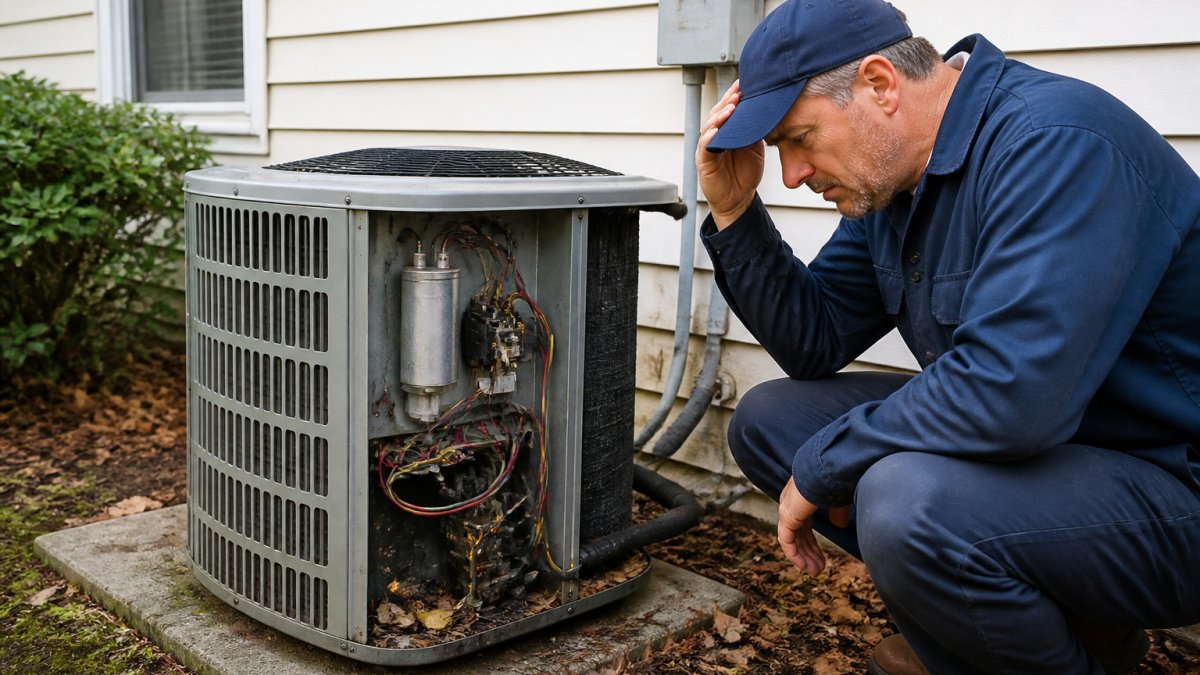
Compliance is not just paperwork. A neglected rooftop unit can leak refrigerant, trip a safety inspection, or push energy bills higher month after month. Many facility managers find that a written check routine catches small faults before they become shutdowns.
Below, we break down what is mandatory, what is simply smart practice, and how to build a checklist that survives an audit.
Commercial HVAC Compliance Requirements: What's Mandatory vs. Best Practice
Commercial HVAC compliance requirements split into two buckets: legal duties you must meet, and maintenance habits that protect your equipment. Mixing them up wastes money. Skipping the legal ones creates real risk. The practical way to separate them is to map each routine check to the requirement that actually drives it, federal rule, adopted code, or voluntary standard, and then confirm which edition your local authority enforces.
Federal Refrigerant Rules Under the Clean Air Act
Refrigerant handling is the clearest legal line. Under Section 608 of the Clean Air Act, technicians who service refrigerant systems must be certified, refrigerant leaks above set thresholds must be repaired, and refrigerant use and repairs must be recorded. The EPA Section 608 refrigerant rules set those requirements and the recordkeeping that goes with them. Two practical points:
- Only EPA-certified technicians may handle refrigerant.
- Leak repairs and refrigerant use must be logged, and those logs are the first thing an inspector asks for.
A common pattern is to treat the refrigerant log as a contractor-only document. It is not. The owner or facility manager is the party who has to produce it, so the log should live with the building's maintenance records, not in a technician's truck.
Ventilation and Indoor Air Quality Standards
Ventilation requirements usually trace back to local building codes, which in turn reference standards like ASHRAE 62.1 for indoor air quality. The ASHRAE 62.1 ventilation standard sets minimum outdoor air rates for commercial spaces. Your local code official decides how it applies to your building, and which edition is enforced. That edition matters: a building permitted under an older code may still be inspected against the edition adopted at the time of permit, while a change of occupancy can trigger the current edition.
The Maintenance Standard Competitors Rarely Mention
ASHRAE Standard 180, Standard Practice for Inspection and Maintenance of Commercial Building HVAC Systems, is the consensus reference that many commissioning agents and insurers use to judge whether a maintenance program is adequate. It is not a federal law, but it is frequently incorporated by reference into specifications, leases, and energy-performance contracts. If your building has a commissioning requirement or a green lease, check whether Standard 180 is named, if it is, your checklist needs to align with it, not just with the equipment manual.
Mapping Each Check to Its Driver
Use this mapping to decide what is mandatory, what is contractually required, and what is simply good practice:
| Routine check | Primary driver | Status |
|---|---|---|
| Refrigerant handling and leak repair | Clean Air Act Section 608 | Mandatory federal |
| Refrigerant use and repair logs | Section 608 recordkeeping | Mandatory federal |
| Outdoor air rates and ventilation | Local code adopting ASHRAE 62.1 | Mandatory as adopted |
| Filter, coil, belt, and drain inspection | ASHRAE Standard 180 or lease/spec | Contractual or best practice |
| Economizer and control verification | Energy code or commissioning spec | Varies by jurisdiction |
| Combustion safety checks | Local mechanical code and manufacturer instructions | Mandatory as adopted |
How to Confirm What Applies to Your Building
Work through four questions before you finalize a checklist:
- What is the building's use and occupancy? Assembly, restaurant, and healthcare occupancies often carry stricter ventilation and exhaust requirements than general office space.
- Which code edition was adopted at permit, and has occupancy changed since? A change of use can pull the building under a newer edition.
- Does a lease, spec, or commissioning contract name a standard? If ASHRAE Standard 180 or a specific 62.1 edition is cited, that becomes your contractual floor.
- Which agency enforces what? Building departments handle ventilation and mechanical code; state environmental agencies handle refrigerant reporting; the EPA handles federal Section 608 requirements. Confirm each separately rather than assuming one office covers all three.
Document the answers. When an auditor or a new owner asks why a check is on the schedule, the mapping table plus the four answers is the explanation.
Your Commercial HVAC Preventive Maintenance Checklist
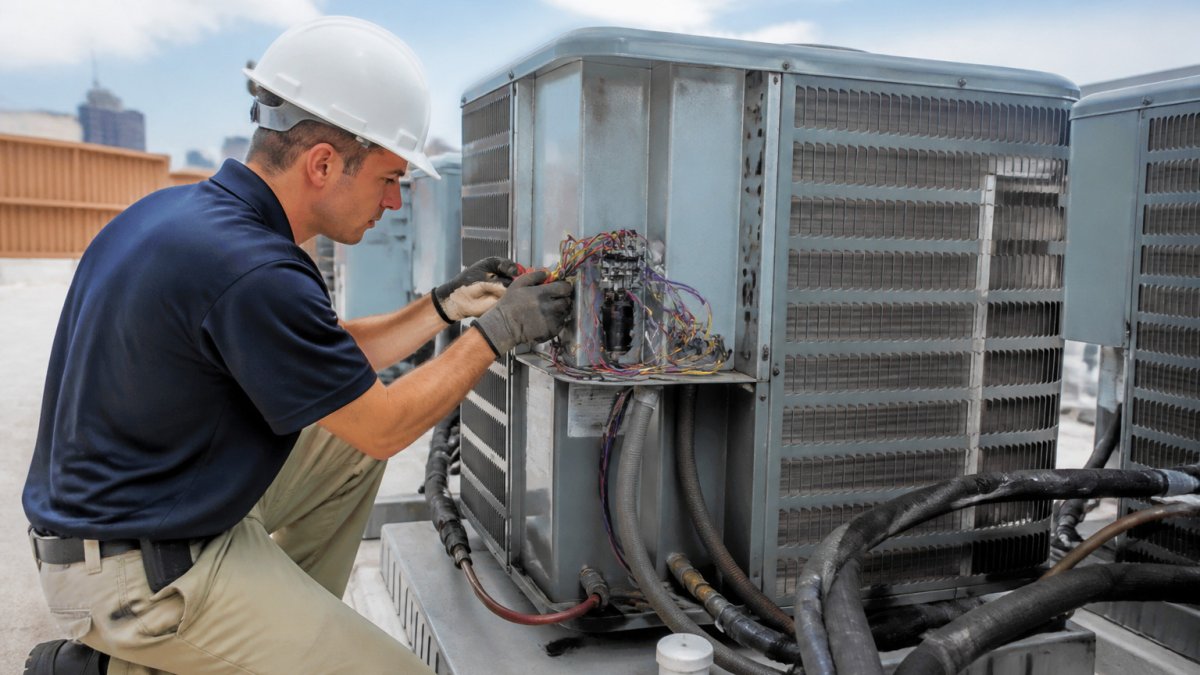
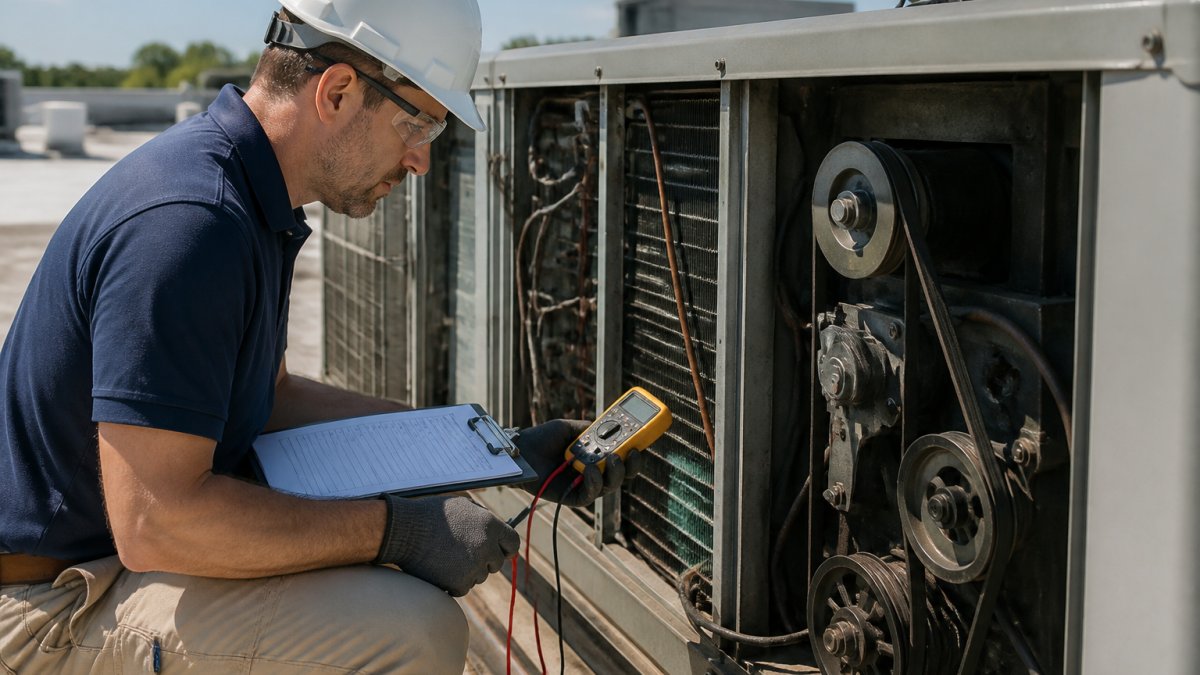
A commercial HVAC preventive maintenance checklist should cover filters, coils, refrigerant, belts, motors, and drains on a fixed schedule. The goal is simple: catch wear before it becomes a failure.
Air Filters and Coil Cleaning
Filters are the cheapest check with the biggest payoff. Clogged filters cut airflow, strain the blower, and raise energy use.
- Inspect filters monthly; replace on pressure drop or visibly loaded.
- Clean condenser coils at least twice a year, more in dusty settings.
- Check evaporator coils for buildup and airflow restriction.
Refrigerant, Belts, Motors, and Drain Lines
The moving parts and the refrigerant loop need eyes on them every visit.
- Check refrigerant levels and look for oil traces that signal a leak.
- Inspect belts for cracks, glazing, and correct tension.
- Listen to motors and check bearings for heat or noise.
Photograph each component during every inspection. A dated photo of a clean coil or a new belt is the fastest way to prove work was done when an auditor or owner asks.
Building a Commercial HVAC Maintenance Schedule That Holds Up
A commercial HVAC maintenance schedule works best when it matches task frequency to risk, not to a generic calendar. Quarterly maintenance suits most commercial systems. Annual maintenance covers deeper checks. Critical equipment may need monthly attention.
| Task | Frequency | Who Typically Handles It |
|---|---|---|
| Filter inspection | Monthly | In-house or contractor |
| Coil cleaning | Biannual | Contractor |
| Refrigerant check | Quarterly | EPA-certified tech |
| Belt and motor inspection | Quarterly | Contractor |
| Drain line clearing | Quarterly | Contractor |
| Full system audit | Annual | Contractor |
Build the schedule around your building's actual use. A restaurant kitchen and an empty office wing have very different loads.
Schedule your complimentary consultation →
Commercial HVAC Maintenance Records: Building Audit-Ready Documentation
Commercial HVAC maintenance records are the proof that your checks happened. Without them, compliance is a claim, not a fact. Most competitors stop at listing fields. The angle that actually holds up in an audit is a record system built around three workflows: the service log, the deficiency tracker, and the proof-of-correction file. Each answers a different question an auditor will ask.
The Three Records Every Building Needs
1. The service log answers "what was done, when, and by whom." One row per task, per visit. Minimum fields:
- Date and time of inspection
- Technician name and certification number (EPA Section 608 certification for any refrigerant work)
- Equipment ID and location (rooftop unit number, AHU, etc.)
2. The deficiency tracker answers "what was found, and what are we doing about it." Every finding gets an ID, a risk rank, an owner, and a due date.
3. The proof-of-correction file answers "was it fixed, and how do we know?" This is the file auditors and insurers ask for and the one most buildings cannot produce.
Sample Log Fields and a Deficiency Tracker Layout
A workable deficiency tracker has these columns:
| Field | Purpose |
|---|---|
| Finding ID | Unique reference for cross-linking to work orders |
| Equipment ID | Ties the finding to the asset |
| Description | What was observed, in plain language |
| Risk rank | Immediate, short-term, or routine |
| Regulatory driver | Section 608, code, lease, or best practice |
| Owner | Who is accountable for closure |
| Due date | Deadline tied to risk rank |
| Status | Open, scheduled, corrected, verified |
| Correction evidence | Photo, reading, or work-order number |
Retention and Storage
Retention periods are set by the requirement that drives the record, not by a single universal rule. Refrigerant records under Section 608 must be kept for the period the regulation specifies, and state environmental agencies may impose their own retention requirements on top of the federal rule. Lease and commissioning contracts often require longer retention than either.
Making Records Audit-Ready Before the Audit
Run a quarterly self-audit against three tests:
- Completeness: Can you produce a service log entry for every scheduled visit in the last twelve months?
- Traceability: Can you take any closed deficiency and show the finding, the work order, and the correction evidence in under five minutes?
- Currency: Are open deficiencies ranked and dated, with no item sitting open past its due date without a documented reason?
A program that passes those three tests will survive a refrigerant inspection, a lease audit, and a change of ownership far better than one that only logs tasks completed.
Who Is Responsible? A Matrix for Owners, Facility Managers, and Contractors
Responsibility for commercial HVAC compliance is shared, and confusion here causes gaps. Here is how we see the split.
| Role | Core Responsibility |
|---|---|
| Owner | Funds maintenance, holds ultimate legal duty |
| Facility manager | Schedules checks, keeps records, tracks issues |
| Licensed contractor | Performs certified work, documents service |
The owner carries the legal weight. The facility manager keeps the system running and the paper trail intact. The contractor does the certified work and documents it. When one party assumes another will handle a task, it tends to fall through.
How to Verify Local Rules and Prioritize Corrective Actions
Local rules vary by jurisdiction, so verify rather than assume. Start with your city or county building department and your state environmental agency. Ask specifically about ventilation rates, refrigerant reporting, and inspection intervals.
Risk-Based Prioritization and Corrective-Action Deadlines
Not every finding is equal. Rank issues by risk and set deadlines.
- Immediate: refrigerant leaks, carbon monoxide risks, failed safety controls. Fix now.
- Short-term: failing belts, blocked drains, dirty coils. Fix within days.
- Routine: minor wear, filter changes, calibration. Schedule on the next visit.
A compliance program that documents risk ranking and deadlines holds up far better in an audit than one that only logs tasks completed.
Conclusion
Keeping a commercial building compliant takes more than a service call now and then. It takes a schedule, real records, and a clear sense of who owns each task. We build maintenance plans around the Willamette Valley climate and back them with transparent reporting.
Schedule your complimentary consultation with Valley View HVAC and get a maintenance plan you can actually defend.
Frequently Asked Questions
What records should I keep for commercial HVAC compliance checks?
Keep dated inspection logs for every unit, refrigerant purchase and disposal records, leak detection and repair documentation, filter change logs, and signed contractor service reports. Store them for at least three years, since refrigerant records under the Clean Air Act are commonly requested in that window. Each record should name the equipment, the technician, the task performed, and the result. Digital files with photos of nameplate data and before-and-after conditions make audits far easier than paper binders.
How often should a commercial HVAC system be inspected?
Most commercial systems need quarterly inspections, with monthly filter checks during peak heating and cooling seasons. ASHRAE Standard 180 sets a maintenance framework many facility managers follow, and refrigerant-containing equipment must be checked for leaks on a schedule tied to its charge size. High-use buildings like restaurants or clinics often benefit from monthly walkthroughs. Your commercial HVAC maintenance schedule should reflect equipment age, occupancy, and local code rather than a single one-size-fits-all interval.
Is a commercial HVAC maintenance contract worth it?
A maintenance contract typically pays off through fewer emergency repairs, longer equipment lifespan, and documented compliance. Contracts also lock in scheduled inspections so nothing slips during busy seasons. The value depends on what the contract covers: confirm it includes refrigerant checks, coil cleaning, belt inspection, and written records you can hand to an auditor. Ask for a clear scope and a corrective-action process, not just a visit count.
How can regular HVAC maintenance improve energy efficiency?
Clean coils, fresh filters, and properly tensioned belts let the system move air with less strain, which lowers energy use. Refrigerant undercharge or a slow leak forces compressors to run longer for the same cooling. Thermostat calibration and building automation system checks keep setpoints accurate so equipment isn't overworking. Documented preventive maintenance also surfaces small faults before they become efficiency-killing failures, protecting both comfort and operating budgets.