 Comparison
7 Aire Serv Alternatives for Commercial HVAC Buyers
Last Updated: November 12, 2026
Quick Summary
The best commercial HVAC alternatives to Aire Serv are local commercial contractors, national service networks, manufacturer service arms, mechanical engineering firms, and in-house plus vendor hybrids. Match the provider type to your building and downtime tolerance, then compare contract terms rather than brand names.
- Aire Serv is a franchise network built primarily around residential heating and cooling calls.
- National providers standardize schedules and reporting, but local crews are often subcontractors.
- Local contractors often reach a site faster because tickets skip a national dispatch center.
- Confirm response times in hours, exclusions, parts sourcing, and price escalation before signing.
- Rank buildings by the cost of an hour of downtime to weigh response commitments over price.
Table of Contents
- Why Commercial Buyers Look Beyond Aire Serv
- Aire Serv Alternatives for Commercial HVAC at a Glance
- National Providers vs Local Commercial HVAC Contractors
- What Commercial HVAC Maintenance Plans Should Cover
- Reading Commercial HVAC Service Agreements Before You Sign
- Your Commercial HVAC Quote Checklist
- Matching the Provider to Your Building Type
- Request a Commercial HVAC Assessment for Your Property
- Frequently Asked Questions
Why Commercial Buyers Look Beyond Aire Serv
Aire Serv is a franchise network built primarily around residential heating and cooling calls.
Here is the first thing most guides get wrong. They compare brand names. Commercial buyers should compare service models instead.
Below, we break down who handles what, what a maintenance plan should include, and how to read a service agreement before you sign it.
Aire Serv Alternatives for Commercial HVAC at a Glance
Commercial HVAC means the heating, ventilation, and air conditioning systems serving non-residential buildings, including offices, retail spaces, restaurants, and light-industrial properties.
The table below summarizes the main categories of alternative, not a ranking of individual companies.
| Provider Type | Best For | Typical Strengths | Watch For |
|---|---|---|---|
| Local commercial contractor | Single-site owners, restaurants, retail | Fast dispatch, familiarity with the building | Confirm commercial depth, not just residential |
| National service network | Multi-state portfolios | Standard processes, one point of contact | Local execution varies by branch |
| Manufacturer service arm | Buildings with proprietary equipment | Factory parts and training | Less flexible on mixed-brand systems |
| Mechanical/engineering firms | New construction, major retrofits | Design and commissioning capability | May not handle routine service calls |
| In-house plus vendor hybrid | Large facilities with staff | Control over daily operations | Needs a strong vendor for specialty work |
The practical takeaway: match the provider type to your building and your tolerance for downtime, not to the biggest name on a search results page.
National Providers vs Local Commercial HVAC Contractors
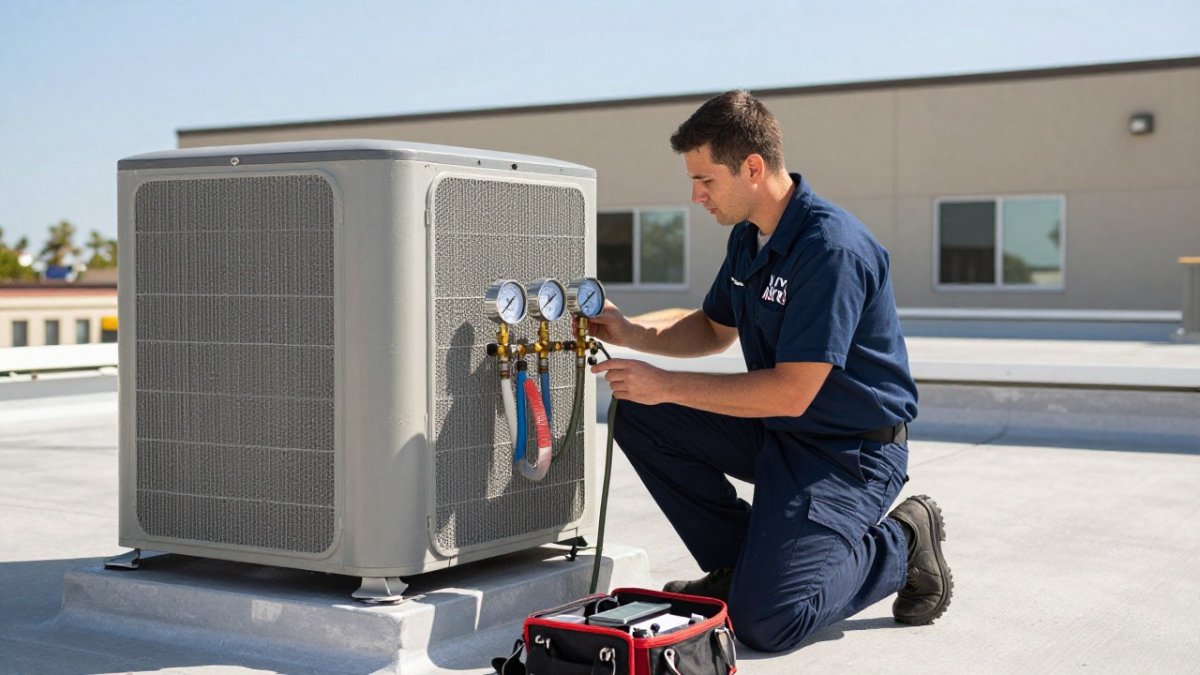
National providers bring structure. Local contractors bring proximity and knowledge of your specific building. The right answer depends on how many sites you run and how quickly you need a technician on the roof.
What a National Provider Handles Well
Multi-site portfolios benefit from consistency. A national provider can standardize maintenance schedules, reporting formats, and escalation paths across locations, which matters when a property manager answers to a regional director. The trade-off is that the crew on your roof is often a local subcontractor operating under a national contract, so response times can vary from market to market.
Where Local Contractors Win on Commercial Buildings
Local commercial contractors know the building stock. They understand how a particular rooftop unit performs in local humidity and temperature swings, and they can often reach a site faster because they are not routing a ticket through a national dispatch center.
If you are weighing a national franchise against a regional provider directly, this Woodward Heating vs Aire Serv comparison lays out the head-to-head factors side by side.
What Commercial HVAC Maintenance Plans Should Cover
A commercial maintenance plan is a scheduled service agreement that keeps heating and cooling equipment running through documented inspections, adjustments, and repairs. The plan is only as good as what it commits to in writing.
Look for these elements before you compare prices:
- Visit frequency tied to equipment type. Rooftop units, split systems, and VRF systems need different service intervals.
- Written condition reports. You want a record of what was inspected and what was found, not just a signed ticket.
- Priority dispatch language. "Priority" means nothing without a stated response window.
- Filter and belt replacement included or clearly priced.
You can review how a structured savings and maintenance plan is organized if you want a concrete example of coverage terms.
Reading Commercial HVAC Service Agreements Before You Sign
Service agreements are where commercial HVAC relationships succeed or fail. The annual price matters less than the commitments attached to it, and most of those commitments live in a handful of clauses that are easy to skim past. Read them in this order.
1. Response time and after-hours coverage
A response commitment should be stated in hours and split by condition. Look for separate windows for emergency no-cool or no-heat calls, routine service requests, and after-hours or weekend calls, plus a stated definition of what counts as an emergency.
Watch out: a plan that promises a four-hour response but routes after-hours calls to an answering service has not actually committed to four hours, confirm who answers the phone at 2 a.m. and where that technician is dispatched from.
2. Exclusions and what triggers extra billing
Exclusions decide whether the plan saves money or just prepays the easy visits. Check specifically for refrigerant, crane or rigging work, electrical beyond the disconnect, ductwork modification, controls programming, and water treatment. Each of these is a common add-on, and a low annual price often depends on excluding several of them. Ask for the hourly rate and trip charge that apply when work falls outside the plan.
3. Parts sourcing and equipment compatibility
Ask whether the provider uses factory-authorized parts or generic equivalents, and how it handles mixed-brand equipment. A provider trained on one manufacturer's line may be excellent on that equipment and slower or less certain on everything else in the building. For a portfolio with several brands, confirm the provider services all of them under the same agreement rather than subcontracting the odd units out.
4. Reporting and escalation
A useful agreement produces a written record: inspection findings, equipment condition, recommended repairs, and a running history you can hand to an owner or lender. Confirm the reporting cadence and format, who receives it, and how a failed inspection escalates. A common pattern is a condition report that flags a failing compressor but no defined step for approving the repair, so the finding sits until the unit fails.
5. Term, cancellation, and price escalation
Multi-year terms should state exit conditions, notice periods, and whether unused visits are refundable. Look for an automatic renewal clause and a price-escalation clause, a plan that renews silently at a higher rate is a common source of friction. Confirm whether the agreement transfers if the building sells.
6. Licensing, insurance, and technician qualifications
Confirm the provider holds the licenses required for the work, carries liability and workers' compensation coverage, and can produce certificates naming your property.
A common mistake is signing a low annual price without reading the exclusions and the escalation clause.
Before you commit, run the bid through the seven questions that separate two HVAC bids.
Your Commercial HVAC Quote Checklist
Use this checklist to compare quotes on equal footing:
- Scope of work written in plain language
- Equipment make, model, and efficiency rating specified
- Manual J or load calculation referenced for replacements
- Permit and inspection responsibilities stated
- Warranty terms for labor and parts listed separately
A quote that skips the load calculation is a red flag. Oversized equipment short-cycles, wastes energy, and wears out faster.
Matching the Provider to Your Building Type
Different buildings demand different providers. A 2,000-square-foot retail space and a multi-story office tower should not be shopping for the same service model, and the fit depends on three things: system complexity, how much downtime costs you, and how many sites you run. Use the profiles below to narrow the field before you request quotes.
Restaurants and food service
Prioritize providers with demonstrated experience on exhaust hoods, makeup air units, and the interaction between kitchen ventilation and the rest of the HVAC system. Emergency response matters more here than anywhere else, because a failed makeup air unit can shut down service. Ask how the provider schedules service around business hours and whether it stocks common parts for rooftop units.
Retail
Retail spaces usually run packaged rooftop units and split systems, and the priority is after-hours scheduling so service does not interrupt sales. Confirm the provider can work outside store hours without a premium, and ask how it handles multiple tenants or a landlord-tenant split on equipment responsibility. For a strip center, clarify in writing which units the landlord's agreement covers and which belong to tenants.
Offices
Offices weight preventive maintenance and indoor air quality more heavily than emergency response, because comfort complaints and air quality concerns drive tenant satisfaction.
Light industrial
Light industrial sites prioritize uptime and documented compliance checks. Ask about experience with the specific equipment on site, process cooling, large packaged units, or specialty ventilation, and confirm the provider can produce the inspection records your insurer or auditor expects. Response time matters, but so does the provider's ability to source parts quickly for less common equipment.
Multi-story and multi-site portfolios
Larger buildings and portfolios shift the question from a single contractor to a service model.
A practical way to decide: rank your buildings by the cost of an hour of downtime. For commercial properties across the mid-Willamette Valley, our commercial HVAC services cover restaurants, offices, retail, and light-industrial sites with scheduled maintenance and service contracts.
Request a Commercial HVAC Assessment for Your Property
Choosing among Aire Serv alternatives comes down to one question: which provider will document its work, meet its response commitments, and know your building well enough to prevent failures rather than just react to them?
At Valley View HVAC, we bring over 20 years of combined construction trades experience to heating and cooling work, backed by full licensing, bonding, and insurance.
Commercial buildings do not forgive downtime. A failed rooftop unit in peak summer costs a restaurant revenue and a retail tenant patience.
Valley View HVAC offers right-sized, high-efficiency equipment, humidity-managing and air quality solutions, and emergency support during extreme weather, backed by a 2-year workmanship warranty. If you are ready to stop comparing logos and start comparing commitments, request a commercial repair and maintenance assessment for your property.
Frequently Asked Questions
What should businesses compare when choosing a commercial HVAC contractor?
Compare licensing and insurance, technician qualifications, response-time commitments, and whether the provider services your building type. Ask for the service agreement in writing so you can see what preventive maintenance visits include and what counts as billable repair. Confirm parts availability for your equipment and whether the contractor handles rooftop units, VRF systems, or air-to-water systems. A provider that cannot name your equipment model and its service history is a risk on a multi-story building.
How do commercial HVAC service agreements work?
A commercial HVAC service agreement sets scheduled preventive maintenance visits, defines response windows for repairs, and states what labor and parts are covered. Most agreements run 12 months and renew automatically, so note the cancellation terms. Look for measurable standards: hours to respond, hours to restore cooling or heating, and whether after-hours calls carry extra charges. Get the escalation path in writing, including who you call when the assigned technician is unavailable.
What should a commercial HVAC maintenance plan include?
A useful commercial HVAC maintenance plan covers filter changes, coil cleaning, belt and bearing checks, refrigerant level verification, and controls testing, with a written report after each visit. It should list how many visits per year and which equipment each visit covers. Ask whether the plan includes priority scheduling during heat waves and cold snaps, and whether it discounts repair labor. Plans that only list visits without naming the tasks make it hard to compare providers.
How can a business compare HVAC repair and replacement quotes?
Put every quote on the same page: equipment make and model, efficiency rating, scope of work, permit handling, warranty terms, and commissioning steps. A lower bid that skips duct sealing, controls verification, or load calculation is not the same job. Ask each contractor to state the assumed building load and why the proposed tonnage fits. For replacements, confirm disposal of the old unit and whether the quote includes a post-install performance check.
What warranties should a commercial HVAC contractor offer?
Separate the equipment warranty from the labor warranty. Manufacturers typically cover parts for a set term, while the contractor covers workmanship. Ask for the workmanship term in writing, what voids it, and how quickly warranty calls get scheduled. Confirm whether the warranty transfers if you sell the building, and whether it covers rooftop curb and rigging work. A two-year workmanship warranty is a reasonable benchmark for installation work.