 how-to
Common Causes of Uneven Home Temperature: A Diagnostic Guide
Table of Contents
- Why Your Home Has Uneven Temperatures: The Root Causes
- Blocked or Closed Air Vents and Restricted Airflow
- HVAC Airflow Problems and System Balancing Issues
- Ductwork Causing Uneven Temperatures
- Poor Insulation, Heat Loss, and Drafts
- Thermostat Location, Settings, and Malfunction
- How to Fix Uneven Temperatures in a Two-Story House
- Dirty Air Filters and HVAC Maintenance
- Frequently Asked Questions
Last Updated: October 21, 2026
Why Your Home Has Uneven Temperatures: The Root Causes
Uneven home temperature is one of the most common complaints we hear, one room feels like an icebox while another is uncomfortably warm.
At Valley View HVAC, we help Willamette Valley homeowners track down why their homes don't heat or cool evenly.
Here's what most guides miss: uneven home temperature isn't always a sign you need a new system, often it's a sign your current system isn't delivering air where it needs to go.
The Most Common Causes at a Glance
- Blocked or closed supply registers and return vents
- Unbalanced airflow from system design or damper settings
- Dirty air filters restricting airflow
Blocked or Closed Air Vents and Restricted Airflow
Restricted airflow is the easiest cause to fix, yet it's often overlooked. When supply registers or return vents are blocked, air can't reach certain rooms, so those rooms fall behind while others overheat.
Furniture in front of vents, closed vents in unused rooms, or dust buildup create significant restrictions. In a two-story home, closing upstairs vents in winter to redirect heat downstairs actually makes things worse by throwing the system out of balance.
How to Check Your Supply Registers and Return Vents
Start with a visual inspection of every room's supply registers (where air comes out) and return vents (where air is pulled back to the system).
Step 1: Check for blockages
- Look for furniture, curtains, or other items blocking vents
- Remove obstructions completely; even partial blockage reduces airflow
- Vacuum dust buildup off registers, which restricts air movement
Step 2: Verify all vents are open
- Supply registers should be fully open unless you have a specific reason to close them
- Return vents must stay open; closing them disrupts system balance
- Check basement or crawlspace vents if your system pulls return air from there
Step 3: Feel the airflow
- Hold your hand near each supply register; you should feel strong, steady air
- Weak airflow at some registers while others are strong signals an imbalance
- Return vents should pull air quietly; if not, something is blocking them
Fixing Restricted Airflow in Your Home
Immediate actions:
- Move furniture away from all supply and return vents
- Open any closed vents completely
- Vacuum registers and vents to remove dust
For persistent problems: If airflow is still weak after clearing obstructions, your air filter may be dirty, a clogged filter restricts airflow throughout the home, making some rooms feel much colder or warmer than others. Uneven temperatures often start with something you can fix yourself in 15 minutes.
HVAC Airflow Problems and System Balancing Issues
Even with clear vents, your HVAC system might not deliver air evenly. Unbalanced airflow occurs when ductwork isn't sized correctly, longer ducts create pressure differences, or dampers favor certain zones.
Understanding Unbalanced Airflow in Your System
Think of your HVAC system as a water distribution network: without managed flow, air takes the path of least resistance. Shorter ducts get more air, longer runs get less, and rooms at the end of a run stay uncomfortable while rooms near the source feel perfect. Multi-story homes compound this: heated air rises in winter, while in summer cool air sinks and upstairs rooms stay warmer.
How to Balance Airflow in a House Using Dampers
Your ducts contain dampers, small doors that control airflow to different zones. Adjusting these dampers rebalances your system without major renovation.
Step 1: Locate your dampers
- Look in the main duct trunk or branch ducts leading to different areas
- They look like small handles or levers on the side of ducts
- Not all ducts have accessible dampers; check your layout or ask a professional
Step 2: Identify which areas need more or less air
- Rooms that are too cold need more air (damper opens more)
- Rooms that are too warm need less air (damper closes partially)
- Make one adjustment at a time; wait 24 hours to see the effect
Step 3: Adjust dampers gradually
- Turn damper handles parallel to the duct to open fully, perpendicular to close
- Start with small adjustments, quarter turns at a time
- Document each change so you can track what works
Step 4: Monitor results over several days
- Record room temperatures morning, afternoon, and evening
- Adjust further only after observing the full effect
If damper adjustment doesn't solve the problem, you likely have a ductwork issue that requires professional assessment.
Ductwork Causing Uneven Temperatures
Your ductwork is the highway for conditioned air. Leaks or design flaws let air escape before it reaches its destination, causing uneven temperatures and wasted energy.
Leaky ducts are surprisingly common: connections loosen, tape deteriorates, and small holes develop over time. In uninsulated attics or crawlspaces, this loss is even more significant.
Identifying Leaky Ducts and Damaged Ductwork
Visual inspection:
- Look for visible gaps where ducts connect to each other or to the furnace
- Check for deteriorated duct tape or missing insulation
- Ducts in attics or crawlspaces should be wrapped in insulation; bare metal ducts lose conditioned air
Performance clues:
- Rooms far from the furnace stay uncomfortable while nearby rooms are fine
- Your system runs constantly but temperature doesn't improve
- You hear whistling sounds from ducts (air escaping under pressure)
Professional testing: If you suspect significant duct leakage, a professional can perform a blower door test to measure how much air your system loses. This quantifies the problem and helps prioritize repairs.
Duct Sizing and Air Distribution Problems
Ductwork must be sized correctly to deliver the right amount of air to each room: too small creates resistance and reduces airflow, while too large lets air move too slowly and lose pressure. Many homes have ductwork sized for the original HVAC system; if you've upgraded equipment or added rooms, your ducts may no longer be adequate, causing some areas to get too much air and others too little.
Schedule your complimentary consultation →
Poor Insulation, Heat Loss, and Drafts
Even with a perfectly balanced HVAC system, poor insulation lets heat escape in winter and enter in summer, undermining your system's ability to maintain even temperatures. Heat loss and gain happen through walls, attics, basements, and crawlspaces, so rooms with poor insulation fall behind no matter how much conditioned air they receive.
Common insulation problems:
- Attic insulation that's settled or compressed over time
- Basement or crawlspace walls with no insulation
- Exterior walls with gaps or voids in insulation
Identifying insulation issues requires a visual inspection of your attic, basement, and crawlspace. If insulation is visibly thin, compressed, or missing in sections, that's your problem area.
Thermostat Location, Settings, and Malfunction
Your thermostat tells your HVAC system when to run. If it's in the wrong location or malfunctioning, your system can't respond correctly to your home's actual temperature needs.
Common thermostat problems:
- Located near a heat source (kitchen, sunny window, lamp)
- Located in a cold spot (exterior wall, drafty hallway, basement)
- Placed in a room that's rarely occupied
Check your thermostat location first. Ideally, it should be on an interior wall in a central location away from direct sunlight, heat sources, and drafts; relocating it can improve temperature consistency significantly.
How to Fix Uneven Temperatures in a Two-Story House
Two-story homes face unique temperature challenges. Heat naturally rises, making upstairs rooms warmer in winter and cooler in summer. This creates temperature imbalance that's predictable but fixable.
Why Multi-Story Homes Experience Rising Heat and Temperature Imbalance
In a two-story home, warm air rises through your home's structure, interior walls, and gaps in the floor between stories. Your HVAC system can't override this physics, only manage it.
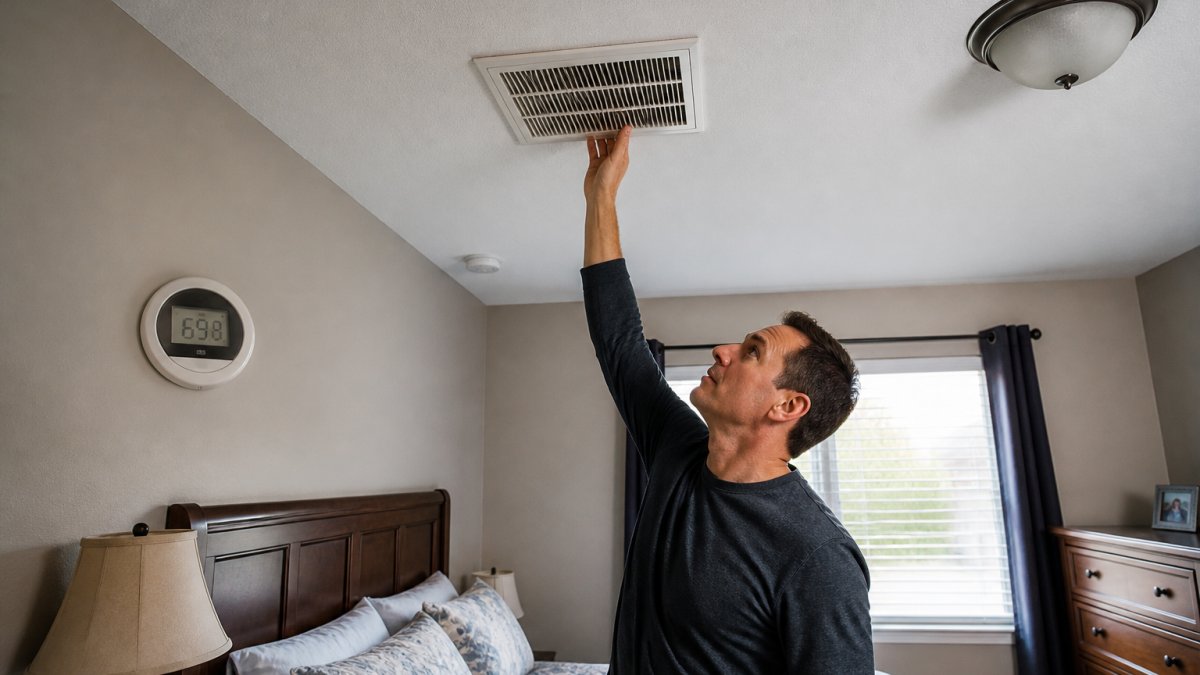
This problem is worse if your thermostat is downstairs: the system reads a comfortable temperature on the first floor and shuts off, leaving upstairs too warm.
Step-by-Step Solutions for Two-Story Temperature Problems
Solution 1: Adjust dampers to favor the cooler story
- In winter, partially close dampers on the main floor to redirect more air upstairs
- In summer, partially close upstairs dampers to push cool air downstairs
- Make small adjustments and monitor for 24 hours before making additional changes
Solution 2: Use zone control if available
- Some systems include dampers with zone controls that automatically balance temperature between floors
- If your system has zone dampers, set them to favor the cooler story
- This requires professional programming but solves the problem automatically
Solution 3: Close vents strategically
- Close some supply vents on the warmer floor to reduce air delivery there
- Never close all vents on one floor; this creates excessive pressure
- Open vents on the cooler floor fully
Solution 4: Upgrade insulation in the attic
- Heat loss through the attic makes upstairs cooler in winter (counterintuitive but true)
- Adding attic insulation stabilizes upstairs temperature and reduces the need for system balancing
Solution 5: Relocate the thermostat
- Move it to a central location between floors if possible
- This helps the system respond to average home temperature rather than one floor's conditions
- If relocation isn't practical, use a smart thermostat with remote sensors in different zones
The most effective approach combines multiple solutions. Start with damper adjustment and vent management. If that's not enough, add insulation improvements and consider thermostat relocation.
Dirty Air Filters and HVAC Maintenance
A dirty air filter restricts airflow throughout your entire HVAC system, making some rooms feel uncomfortable while others seem fine. It's one of the easiest problems to fix but one of the most overlooked.
Signs your filter needs replacement:
- Reduced airflow at supply registers throughout your home
- System running constantly but not reaching set temperature
- Visible dust on the filter (hold it up to light and look for blockage)
Filter replacement schedule:
- Standard filters: replace every 1-3 months depending on use and pets
- High-efficiency filters: replace every 6-12 months
- Check your filter monthly; don't wait for the recommended interval
Replacing a filter takes 5 minutes and most cost between $15-$40, the cheapest maintenance task you can do to improve HVAC performance. Beyond that, regular HVAC maintenance keeps your system balanced and efficient:
- Annual professional maintenance before heating season
- Cleaning supply and return vents
- Inspecting ductwork for leaks or damage
Uneven home temperature is frustrating, but it's almost always fixable. Start by checking vents and air filters, these simple steps solve many problems. If those don't help, move to damper adjustment and insulation assessment.
At Valley View HVAC, we help homeowners throughout the Willamette Valley diagnose and fix temperature imbalance. We offer a complimentary consultation to assess your HVAC system and recommend solutions tailored to your home's specific needs. Schedule your consultation with Valley View HVAC and take the first step toward consistent, comfortable temperatures year-round.
Frequently Asked Questions
Why are some rooms in my house hotter or colder than others?
Uneven home temperature usually stems from blocked vents, duct leaks, poor insulation, or thermostat problems. If one room stays consistently warmer or cooler, check whether its supply registers are fully open and whether drafts or air leaks are present near windows and doors. In two-story homes, heat naturally rises, leaving upper floors warmer and lower floors cooler, a common cause of room-to-room temperature differences.
Can a dirty air filter cause uneven temperatures in a home?
Yes. A dirty air filter restricts airflow throughout your HVAC system, reducing the amount of conditioned air delivered to rooms. This forces your system to work harder and can create unbalanced air distribution, leaving some rooms colder or warmer than others. Replace your air filter every 1-3 months, depending on household dust and pet hair, to maintain consistent airflow and system efficiency.
How do I balance airflow in a house myself?
Check all supply registers and return vents to ensure they are fully open and unblocked. If your ductwork has balancing dampers (metal flaps inside ducts), you can partially close dampers in rooms that receive too much air, redirecting flow to rooms with insufficient heating or cooling. Make small adjustments and wait 24 hours to see the effect. If you're unsure where dampers are located, a professional can identify and adjust them safely.
When should I call an HVAC technician about uneven temperatures?
Contact a professional if you've checked vents and filters but temperatures remain uneven, if you suspect duct leaks or damage, if your thermostat is malfunctioning, or if your system is over 10 years old and struggling to maintain consistent temperatures. Professional technicians can measure temperature differences accurately, inspect ductwork, and assess whether your equipment is properly sized for your home.